
Trumbull Parole Versus Probation
Parole and probation both allow a person to live outside a jail or prison under rules, but they begin in different ways. Traditional parole follows release from an eligible Ohio prison term after action by the Ohio Parole Board. Post-release control also follows prison and is administered by the Ohio Adult Parole Authority, or APA. Probation is the common plain-language term for court-ordered community control. Trumbull County Adult Probation supervises felony community-control cases from Common Pleas Court. Municipal probation departments supervise cases from their own courts.
The source must match the sentence. The ODRC Offender Search can verify APA supervision after state prison. A person who received only local community control may not appear there at all. For that case, use the sentencing docket and the relevant probation office. Neither record should be used as a substitute for the other.
| Question | Parole or post-release control | Probation or community control |
|---|---|---|
| What comes first? | An Ohio prison term | A sentence imposed by the court, sometimes without prison |
| Who oversees it? | Ohio Adult Parole Authority | Trumbull Adult Probation or the sentencing municipal court |
| Best public starting point | ODRC status and supervision fields | Court docket and journal entry |
| How can it end? | Agency discharge or early termination | Court termination or discharge |
- Parole
- Conditional release from an eligible prison term after Board action.
- Community control
- Ohio's court term for sanctions commonly called probation.
- Post-release control
- APA supervision that follows certain prison sentences.
- Discharge
- The formal end of custody or supervision authority.
Check Trumbull Post-Release Supervision
Begin with custody history, not an assumption based on where the person lives. ODRC's public status vocabulary includes Incarcerated, Released, APA Supervision, and Violators at Large. APA Supervision is strong evidence that a person left prison under state supervision. Released can confirm an earlier ODRC exit, but it does not prove that all supervision has ended. The Trumbull court docket is the better source for community control, judicial release, violations, and a local discharge order.
- Search ODRC by the exact offender number when known. Otherwise use the full name and repeat the search with the broad All status.
- Match date of birth, offender number, county of commitment, docket, and offense. Do not rely on a name alone.
- Open the detail record. Read Current Status with Supervision Start, supervision period, residential county or ZIP, and APA office.
- Search the sentencing court docket. Common Pleas handles felony cases, while municipal and district courts keep their own matters.
- Read the journal entry for community control, judicial release, violation, termination, or discharge. Contact the office named in that record if public verification is still needed.
The full county release-confirmation route is also set out on the Trumbull County released inmates search. That route pairs the historic jail episode with the controlling court entry when state supervision is not involved.
Note: A last-recorded residential county or ZIP is an administrative field, not proof of the person's present physical location.
Trumbull Probation Office Records
Trumbull Adult Probation supervises felony community-control cases for Common Pleas Court. Its official FAQ also explains that much information about supervised people and cases is confidential. That limit is important. No public name-search tool for county probation was verified, so the court docket should establish the sentence before a caller asks what the office can confirm.
Trumbull County Adult Probation
106 High Street NW
Warren, OH 44481
330-675-2531
Monday through Friday, 8 a.m. to 4 p.m.
Ask about the office's public verification practice, not confidential case details. Give the case number when available. A municipal case goes to that municipal court's probation department instead. The Adult Probation office cannot certify an ODRC prison discharge, just as ODRC cannot certify a local probation order.
The official Adult Probation FAQ shows the local supervision distinction and points users toward court processes. This screenshot reflects that official source and helps separate local community control from state APA supervision.
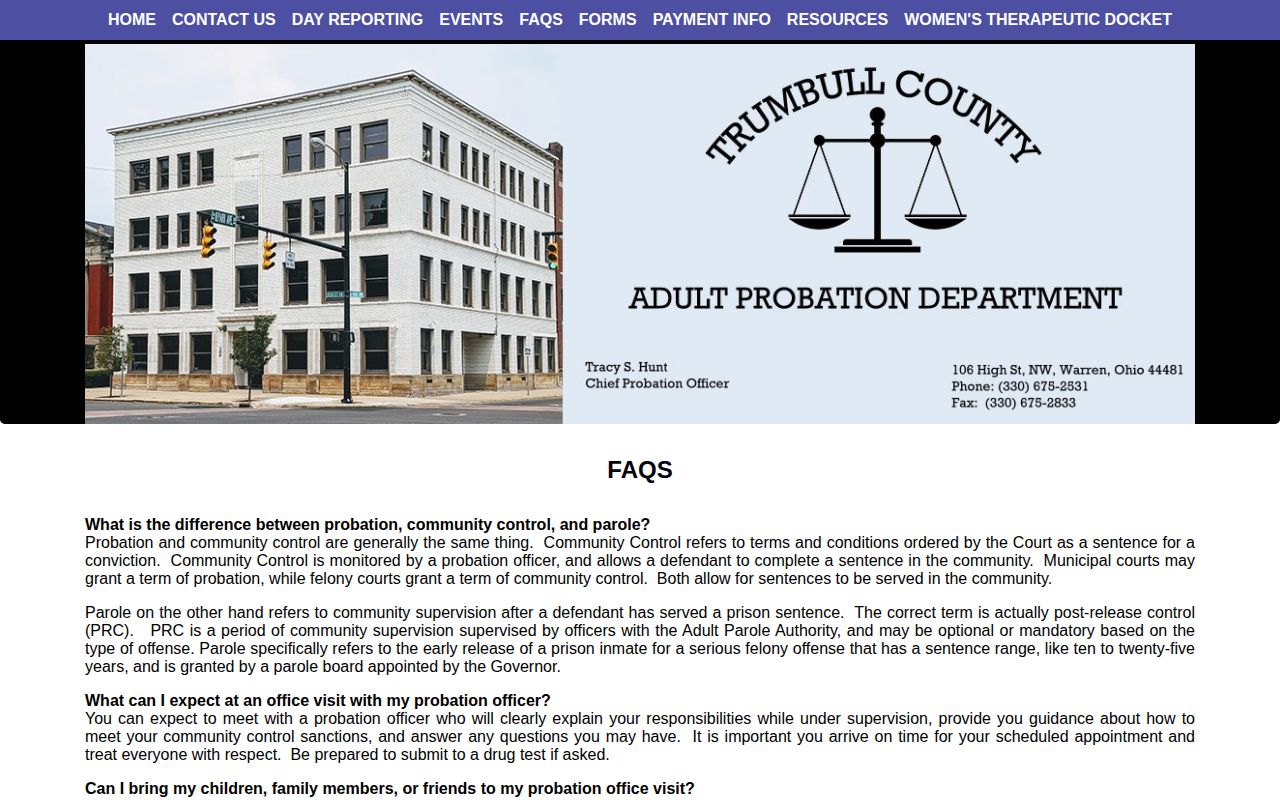
The office page supplies local procedure, while the signed journal entry remains the best record of what the court ordered.
Trumbull Parole Hearing Records
The Ohio Parole Board operates within APA. Its handbook states that release-consideration hearings occur monthly, generally by video from the institution. The live ODRC search accepts a Next Parole Board Hearing Date in YYYYMM form. On an individual record, the next hearing month is only a schedule. It is not a release order or a promise that parole will be granted.
Read the Latest Parole Board Hearing or Review Type and Results field with current status. Published result types can include a continued hearing, Full Board or parole action, a denied transitional-control review, or an imposed additional term. There is no verified standalone archive containing every decision. When more detail matters, request the public Board determination, order, or resulting minutes. Eligibility under ORC 2967.13 means the person may be considered. It does not mean release was approved.
The official ODRC search shows the status filters, county field, and hearing-month field used in this process.
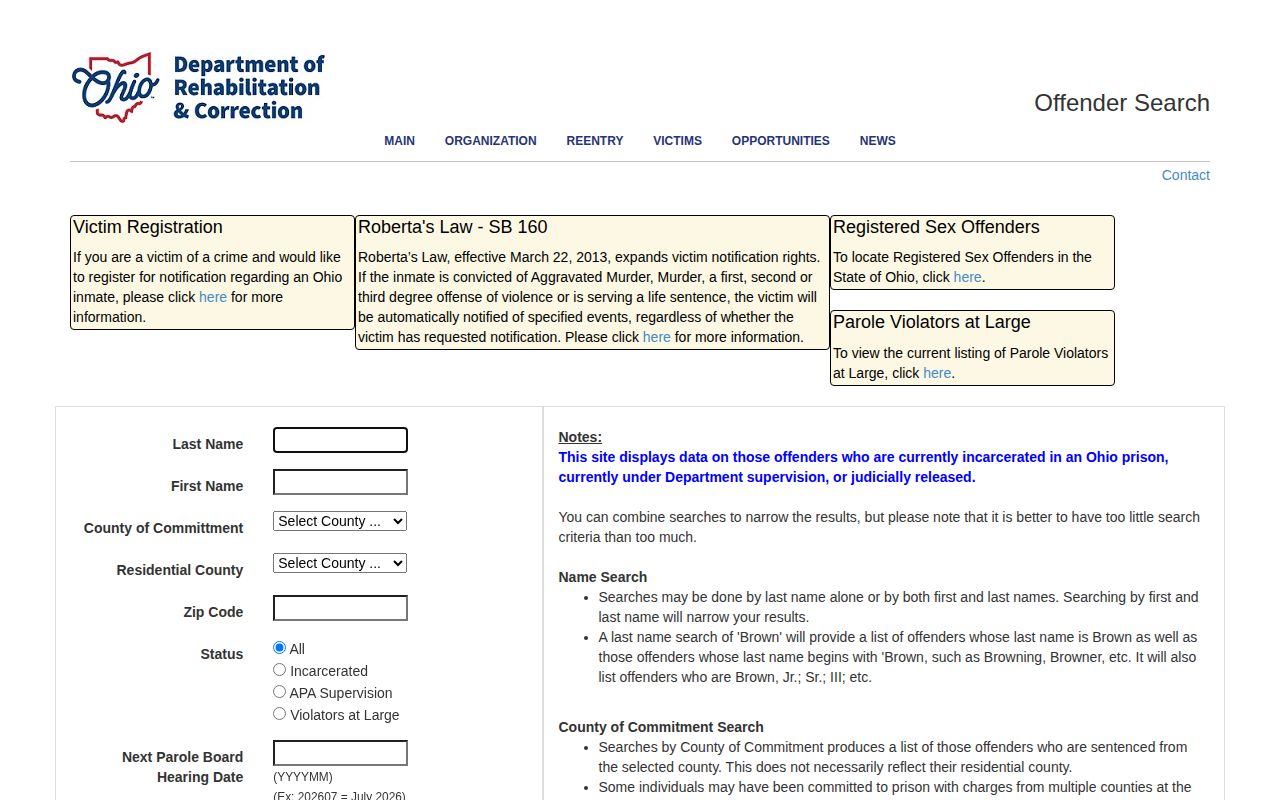
Those filters help locate the right state record, but the detail page and Board result supply the meaning.
Trumbull Supervision Violations
A violation allegation does not mean the same thing in every supervision system. A local probation violation is handled through the sentencing court and its docket. An ODRC status of Violator at Large, often shortened to VAL, means APA considers the person at large after a supervision violation under Ohio law. It confirms unresolved supervision status. It must not be described as a routine release.
An absconder is a supervised person whom the agency says stopped reporting or otherwise left supervision without approval. A warrant or violation entry can follow, but no official public Trumbull County warrant-name list was verified. Use the exact wording in the court or ODRC record. Do not infer the person's current location or claim that every alleged violation produced a warrant.
Ohio VINE can send notices for some state events, including parole revocation or return, release from parole, and certain review milestones. It is a notice service, not a complete supervision file. Confirm a notice through ODRC, the Board result, or the sentencing court. Conditions themselves vary by order, so broad summaries should never replace the person's filed terms.
Note: A supervision violation can change status without creating a new county-jail booking at the same moment.
Trumbull Reentry Court Supervision
Trumbull County has a distinct court-based route after confinement. Common Pleas Rule 24 created the Trumbull Reentry Court effective June 26, 2023. A case may enter when the person receives community control, judicial release, or completes a prison sentence. That makes the court docket a useful bridge between the custody record and structured supervision in the community.
Admission is discretionary. No one has a legal right to participate, and inability to pay fees, court costs, or restitution is not a bar. The team includes the court, prosecutor, public defender, NEOCAP, and Adult Probation. The court record can therefore show a transition that is not visible as an ordinary jail book-out.
The Common Pleas Rules of Court provide the formal local terms. A court entry should be read with any ODRC status if prison preceded the case. One record documents the legal transition; the other can document state custody or APA control.
NEOCAP Trumbull Supervision Path
NEOCAP Warren is a regional male community-based correctional facility with a rated capacity of 125. It is a minimum-custody program, not the Trumbull County jail. Its service area includes Trumbull, Lake, Portage, Geauga, and Ashtabula counties. A person may be placed there through the court and supervision system rather than through an ordinary county book-out.
Program completion or termination must be read through NEOCAP documentation, the sentencing docket, and Trumbull Adult Probation as appropriate. Official accreditation material says negative terminations are commonly returned to probation or prison. Thus, departure from the Warren facility does not by itself prove the person completed supervision or returned to the community without conditions.
The NEOCAP contact page identifies both regional facilities. Match the location and sentencing case before requesting confirmation.
Property Before Trumbull Supervision
Release planning can start before a supervision appointment. At the Trumbull County Adult Justice Center, the jailed person must request the Sheriff's Property Release form. Staff will not relay an outside request for that form. Eligible items of value and property in a clear bag may be picked up daily from 8 to 11 a.m. or from 6 to 10 p.m. A person going to prison or another agency must release all property.
This process does not confirm parole or probation. It is a separate jail procedure that can matter when a person moves to ODRC, NEOCAP, or community supervision. The Sheriff's Inmate FAQ is the source for the form, pickup windows, and transfer rule. The recipient should follow jail instructions rather than ask Adult Probation to arrange property pickup.
Keep the custody change and the supervision start in sequence. A property release may happen before physical book-out. An APA supervision date may follow a state-prison exit. A Common Pleas order may precede both while staff process the transition.
Trumbull Supervision Discharge Records
Supervision ends through an agency or court action, not merely with the passage of a displayed date. ODRC may show an Expiration of Supervision Term, Supervision End Date, or Early Termination field. Read that field with Current Status because the displayed supervision period can relate to another offense. For county community control, use the Trumbull sentencing docket for a termination or discharge entry.
Ohio law draws a line between public facts and the full file. ORC 5120.21 permits release of listed ODRC facts while the underlying inmate and APA file is generally not public. OAC 5120-9-49 identifies releasable supervision history by date and type and public Board determinations, orders, and minutes. Ohio's general public-record rule, ORC 149.43, still operates subject to those specific limits.
When the public screens do not settle the issue, request an existing record. Give the ODRC number or court case number and ask for the discharge or termination entry by date. Do not ask an office to calculate status or offer a present-location conclusion.