
Trumbull Projected Versus Actual Release
A scheduled or projected date tells when release may occur if the present sentence, credits, court orders, and holds remain as recorded. An actual release date records the end of a custody episode after staff complete the legal and operational steps. Trumbull County PublicView can show both Scheduled Release Date and Release Date. They are not interchangeable. The scheduled field is a planning value. The release field is evidence that the identified county booking ended.
ODRC uses an even more careful label: Expected Release Date/Parole Eligibility Date. On one sentence it may be a projected release. On another it may be only the first date when parole can be considered. Eligibility is not approval. The current status, sentence type, next Board month, latest Board result, and supervision fields must be read with it.
A person awaiting trial has no sentence-based end date. Bond may be set, changed, or posted, yet another hold or court order can prevent release. A county sentence, state term, or parole process creates a different kind of date. Start by classifying custody.
Find Trumbull Projected Release Dates
Use the system that computes the term. The county jail records its own booking and scheduled-release fields in Trumbull PublicView. The sentencing court controls its journal entries and jail-time credit order. ODRC computes state-prison sentence data. Searching the wrong system can produce a blank result even when a valid record exists.
- Identify the holding agency and sentence type. Check Trumbull PublicView for a county booking, or ODRC when state imprisonment is known.
- For ODRC, search the exact offender number if available. Otherwise use the name, then match date of birth, county of commitment, docket, judge, and offense.
- Open the detail page and preserve the full Expected Release Date/Parole Eligibility Date label. Read it with Current Status, sentence components, jail-time credit, and Board fields.
- For the Adult Justice Center, inspect Scheduled Release Date but verify the sentence and credit in the linked court docket. A pretrial record may have no fixed date.
- Call the jail or request the existing record when a local field is unclear. Ask ODRC Central Records for existing state sentence or release data when the public detail is not enough.
The Trumbull County released inmate search explains how an actual county release is confirmed after the projection. It also shows why a person who leaves the county jail for ODRC has transferred, not returned to the community.
Note: County of Commitment means the sentencing county, not the prison's location or the person's reported home county.
ODRC Trumbull Release Date Fields
The ODRC detail record contains the facts needed to interpret a state date. It can list admission date, institution, current status, offenses, effective sentence date, jail-time credit, sentence parts, aggregate sentence, county, docket, and judge. It can also show the combined expected-release or parole-eligibility field, next Board month, latest hearing result, and supervision information.
| ODRC field | How to read it |
|---|---|
| Current Status | Distinguishes Incarcerated, Released, APA Supervision, or Violator at Large. |
| Expected Release Date/Parole Eligibility Date | May be a projection or only the point at which parole review can begin. |
| Jail-Time Credit | Records qualifying prior confinement credited toward the term. |
| Next Parole Board Hearing Date | A scheduled month, not a release decision. |
| Latest Board Result | Provides the outcome of the latest listed hearing or review. |
| Supervision Start or POA/PRD date | Can corroborate a prison exit into APA supervision when read with status. |
The official field definitions explain the combined date and related status terms.
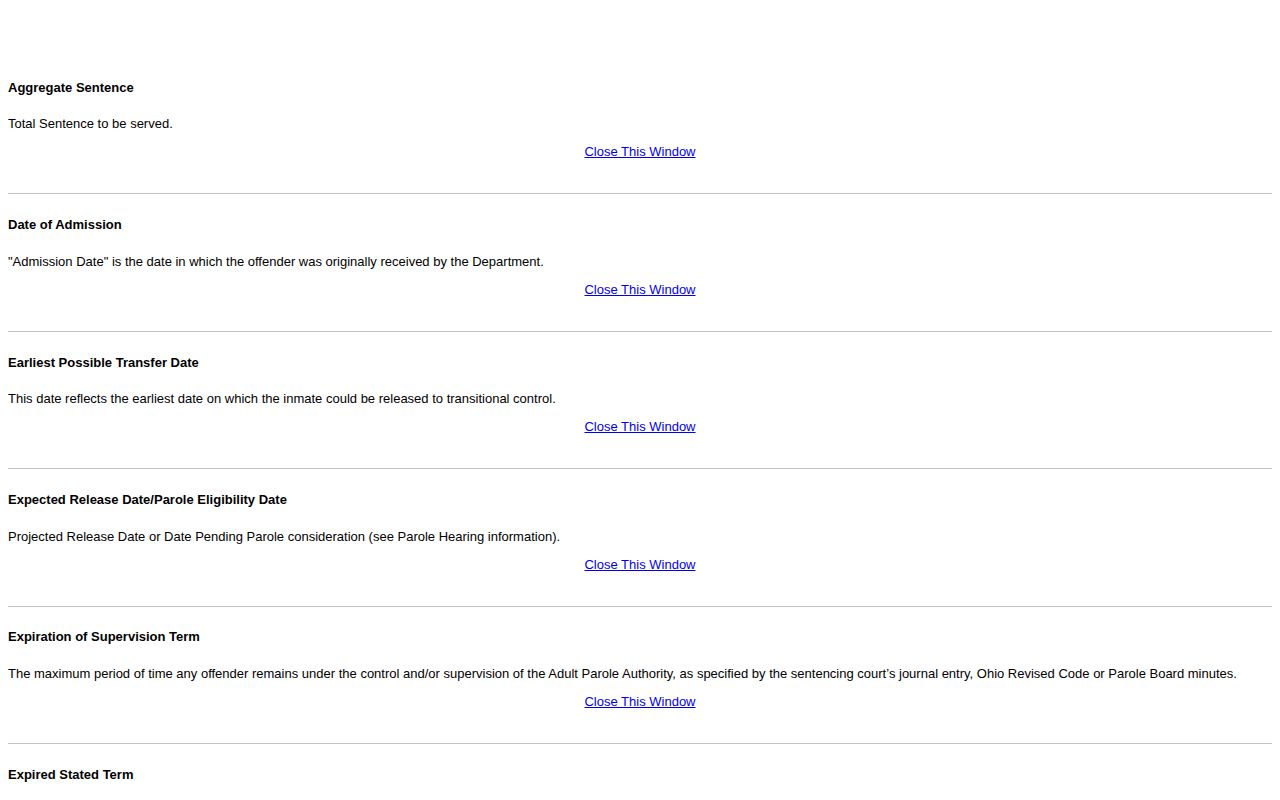
The label itself prevents a common error: a parole-eligibility date cannot be shortened into a promised release date.
Trumbull Jail-Time Release Credit
Ohio's jail-time credit rule appears in ORC 2967.191. It requires a reduction for qualifying confinement tied to the offense. That can include time held in lieu of bail, certain competency or sanity examination confinement, time awaiting prison transfer, qualifying juvenile confinement, and earlier ODRC time for the same offense. The sentencing entry and ODRC detail may display that credit.
This is not a safe do-it-yourself calculation. The court and ODRC apply the record to the legal term. A credit correction normally requires court or agency process. Days from unrelated custody may not count, and the public record can be incomplete. Ask for the sentencing entry or existing calculation rather than asking a records office to create a new date.
Trumbull County's jail Scheduled Release Date is a separate local field. No official county-jail good-time formula was verified in the reviewed sources. Do not apply the ODRC earned-credit rate to an Adult Justice Center sentence. Confirm the local schedule with the jail and the Common Pleas case search.
Ohio Credit Changes Trumbull Dates
For confinement on and after April 4, 2024, ORC 2967.194 permits qualifying people to provisionally earn one or five days per completed month of productive activity or program participation, depending on the statutory category. Certain program or diploma completions can yield 90 days or 10 percent of the stated term, whichever is less. Apart from that separate completion category, the aggregate participation and completion credit is capped at 15 percent.
Awarding credit is not automatic. ODRC records provisional credit monthly, may deny or withdraw it for rule violations, and finalizes it after review. The law excludes several terms, including non-reducible terms, murder categories, life without parole, certain Chapter 2971 sentences, and specified sexually oriented offenses. ORC 2967.193 governs relevant earlier confinement.
That is why a blanket claim that every Ohio prisoner serves 85 percent is wrong. Only an otherwise eligible person who receives the full 15 percent reduction roughly reaches that figure before other adjustments. Many sentences do not qualify. The official statute page shows the current cap and exclusions.
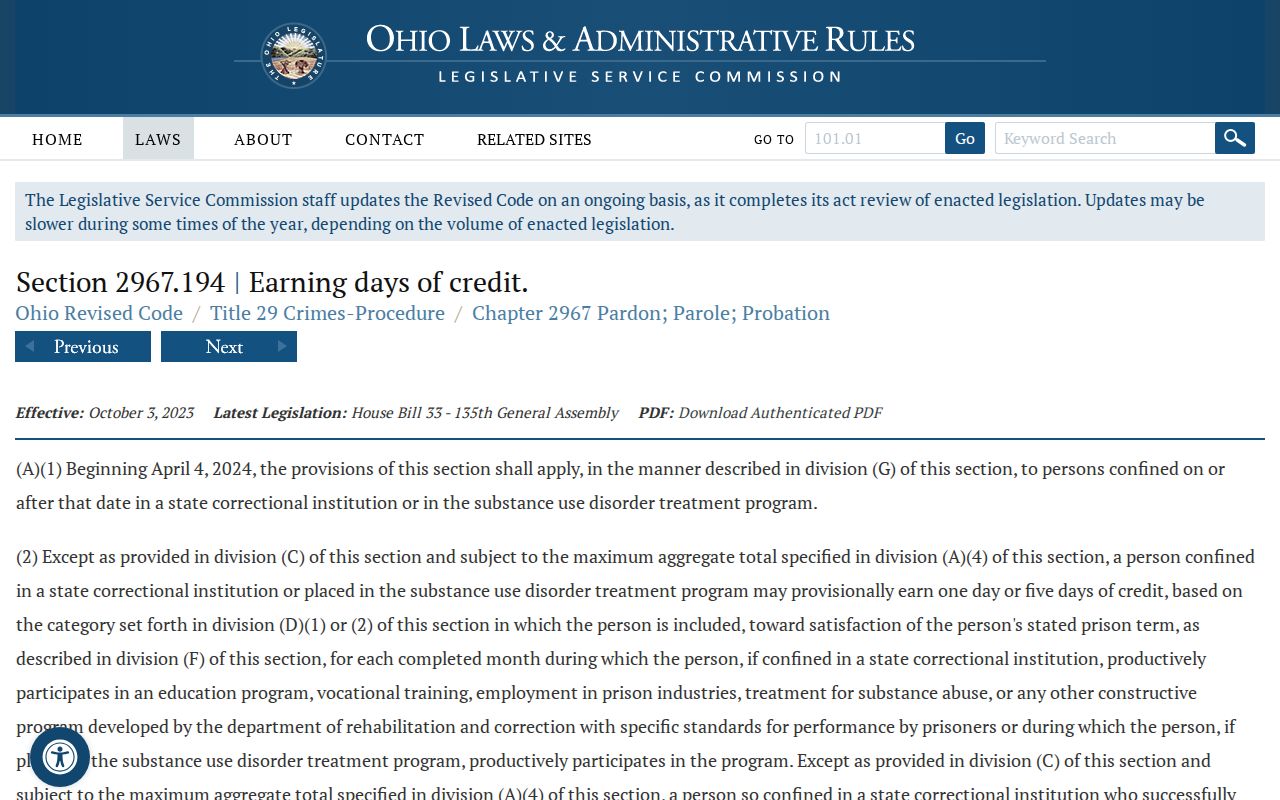
The statutory text supports the limits, while ODRC's individual record supplies the date actually being used for that person.
Why Trumbull Release Dates Change
A projection changes when the facts or legal authority behind it change. Some changes move the date sooner. Others delay physical departure or replace community release with another custody. Record the change by source rather than trying to reconcile the sentence with mental arithmetic.
| Factor | Possible effect | Best confirming record |
|---|---|---|
| Earned credit | Can reduce an eligible ODRC term after award and review | ODRC detail and credit record |
| Credit loss or denial | Can remove an assumed reduction | ODRC computation or decision |
| Jail-time credit | Reduces a qualifying sentence for prior confinement | Sentencing entry and ODRC field |
| Court order | May correct credit, impose a term, or authorize judicial release | Signed journal entry |
| Parole Board action | May grant, continue, or deny a discretionary path | Board result, determination, or minutes |
| Detainer or other hold | May lead to transfer instead of community release | Holding agency and case record |
| Violation or additional-term process | Can continue confinement within the lawful maximum | ODRC status and hearing result |
A detainer is a request or legal basis for another agency to take custody. Therefore, the end of one agency's term may lead to ODRC, another county, federal custody, or immigration custody. It should not be reported as an unconditional return home.
Note: A court order may be entered before jail staff receive it and complete the physical book-out process.
Trumbull Indefinite Release Dates
Qualifying non-life first- and second-degree felony indefinite terms follow ORC 2967.271. The law creates a presumption of release at the minimum or presumptive earned early date. ODRC may rebut that presumption at a hearing and continue confinement for a stated period, but not past the maximum term. The process can occur again.
This framework differs from traditional discretionary parole. Traditional parole eligibility under ORC 2967.13 marks when an eligible person may be considered. Some life categories require specified minimum terms, while life without parole is excluded. The ODRC record's sentence type and latest Board result help distinguish the paths.
A director-recommended reduction for exceptional conduct can reduce part of the minimum term under its own rules. It is distinct from ordinary earned credit. Do not combine the percentages or assume either was granted merely because the person has participated in programming.
Trumbull Transitional Control Dates
ORC 2967.26 permits transitional control during the final 180 days through a licensed facility or an approved residence with electronic monitoring. A person may leave the prison building while remaining under ODRC authority. That is not final discharge.
ODRC records can contain Earliest Possible Transfer Date, TC/TT Sentence Expiration, or related transitional-control data. Keep those labels intact. A move to a community facility is a transfer within a controlled phase, while APA Supervision records a different post-prison status. The practical date may also depend on an approved placement and agency action.
NEOCAP is another local source of confusion. Its Warren and Painesville facilities are regional community-based correctional facilities connected to court sentences and probation. Program completion or termination is documented through NEOCAP, the sentencing court, and supervision system. It is not an Adult Justice Center book-out or an ODRC final discharge.
Confirm Trumbull Actual Release Dates
A projection becomes history only after the responsible source records the custody change. For a county booking, follow the Sheriff's Historic Inmates directions and inspect the matching Booking ID and Release Date. Check for a later active booking. Then use the court case number to read the legal reason. For state prison, read ODRC Current Status. APA Supervision confirms exit from prison under departmental supervision, while Released confirms a prior ODRC departure subject to other-custody checks.
VINELink can add a pending custody-change alert, but it does not replace the agency record. Registration is most useful while the person is still in custody. The Trumbull County VINELink check explains the specific-person search and channel confirmation steps.
If a state field remains unclear, request existing data from ODRC Central Records, P.O. Box 430, Columbus, Ohio 43216. Include the offender number and ask for the release or discharge date, cause and terms, sentencing entry, and public Board determination or minutes as relevant. For a county term, give the Sheriff the Booking ID and date range. Neither office should be asked to invent a new projected date.
Keep a dated copy of the source label when timing matters. Public values can change after credit review, a new order, or a custody handoff, so the latest agency record controls the next check.